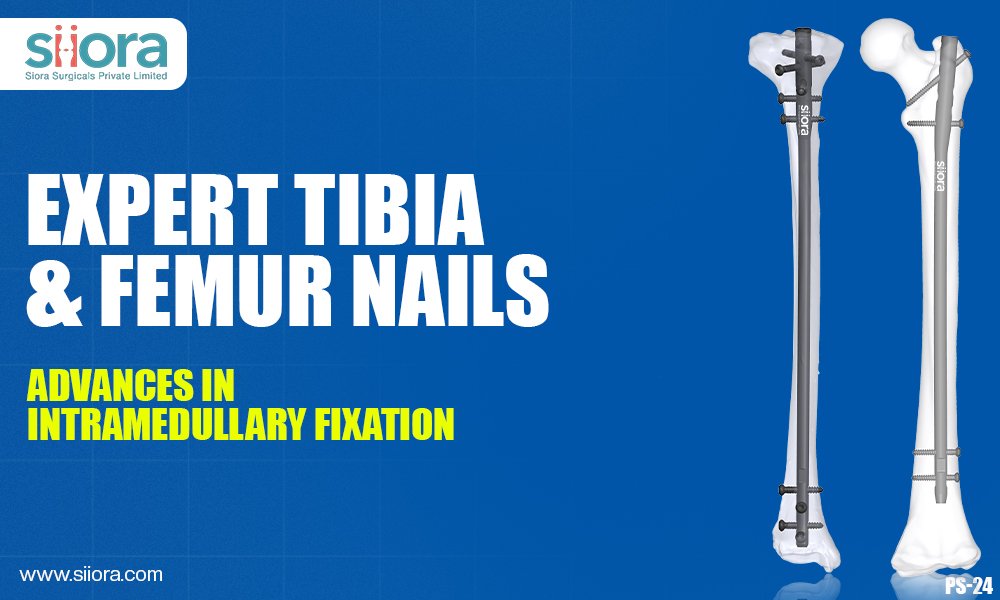
Think of the tibia or femur as a building column. Placing support inside, instead of bolting things around it, makes the whole structure steadier and more natural. That’s essentially what intramedullary nails do. They turn the bone itself into its own protective frame.
Over the past decade, the design of these nails has gotten much smarter. The early versions were basically straight rods. They worked, but they didn’t always fit the natural curves of a bone. Today’s versions of expert tibia and expert femur nails are anatomically contoured, so the nail matches the bend of the femur or the shape of the tibia. That small detail cuts down on discomfort and makes it easier for the fracture to heal in its proper alignment.
The Latest Improvements
Here’s where things get interesting:
Locking systems
Modern nails use multidirectional screws that “lock” into the nail, controlling rotation and preventing the bone fragments from twisting or shifting. Some even allow controlled movement at the fracture site, which can encourage bone healing.
Less invasive surgery
With better instruments and targeting arms, surgeons can now insert these nails through smaller incisions. Less muscle and tissue disruption often means less pain and quicker recovery.
Adaptability
Complex fractures—like those that shatter into multiple pieces—can also be managed better with current nails, since surgeons can customize screw placement to add stability where it’s needed most.
Imaging support
Nails today are easier to place accurately thanks to better compatibility with real-time imaging. This shortens operative time and reduces radiation exposure for both staff and patient.
What It Means for Patients?
The real win here is recovery. Patients with tibia or femur nails are usually encouraged to get moving earlier. Instead of waiting months before putting weight on the leg, many can start walking with support within weeks. This early mobility reduces complications like blood clots or muscle wasting and helps maintain independence.
One patient example comes to mind: a middle-aged man with a motorcycle accident fracture of his femur. With older methods, he’d likely have been in some form of immobilization for months. Instead, with a modern interlocking femoral nail, he was walking with a crutch within three weeks and was back at light work by the third month. Stories like this highlight the impact of these technological changes—not just on healing bones, but on restoring lives.
Where We’re Headed?
Looking ahead, nails are set to get even smarter. Researchers are exploring materials that integrate with bone or stimulate healing. There’s talk of 3D-printing patient-specific designs that perfectly match someone’s anatomy. Add in robotic guidance and AI planning, and intramedullary fixation will likely keep getting more precise and reliable.
Final Thoughts
Expert tibia and femur nails represent how far orthopedic technology has come. They’re stronger, more adaptable, and friendlier to both patient and surgeon than ever. The concept is simple—use the bone’s natural canal as the foundation for stability—but the design refinements have been huge.
For patients, that translates to less downtime, fewer complications, and a faster return to normal activities. For healthcare systems, it’s reliable outcomes and efficient surgeries. And for anyone who has ever faced a broken leg, it’s reassurance that the tools we have today are designed to get them back on their feet, literally, as soon as possible.
If you want to become a partner of an established and trusted orthopedic brand, Siora Surgicals Pvt. Ltd.may end your search. With over 3 decades of experience, the company has presence in over 50 countries and is also looking for distributors of orthopedic implants in Belarus to expand its reach.
 Orthopedic Supply Companies
Leave a comment